Tag Archive for: real estate

home value calculator

Home Appraisals vs. Online Home Value Calculators for Vancouver Island Homeowners

Understanding the Difference Between Professional Appraisals and Automated Estimates on Vancouver Island

When you use a home value calculator, you get an instant estimate with very little effort, but is that number actually reliable? Whether you are trying to figure out what your property may be worth before listing it, refinancing, or simply satisfying curiosity, the tool you choose matters more than most homeowners realize.

You can hire a certified appraiser who will spend time thoroughly evaluating your property, or you can type your address into an online calculator and get a result in seconds. Both approaches claim to tell you what your home is worth, but they differ significantly in accuracy, reliability, and the situations in which each is appropriate.

Key Takeaways

  • Professional appraisals – certified experts visit your property in person, while an online home value calculator relies on algorithms that pull data from public records.
  • Accuracy – Appraisals deliver more accurate results because the appraiser can assess your home’s unique features firsthand. Online tools offer convenience, with instant estimates available at any time.
  • Cost and speed – Online home value calculators are free and return results immediately. Professional appraisals are a worthwhile investment, with fast turnarounds.
  • When each tool applies – You will often need a professional appraisal for mortgage applications, legal matters, and estate planning. An online home value calculator works well when you simply want a general idea of what your property might be worth.
  • Unique and renovated properties – Professional appraisers are especially helpful here. Online calculators often struggle because their data may be outdated, and they cannot account for a home’s current condition or recent upgrades.

What Is a Professional Home Appraisal?

A professional home appraisal is an independent evaluation of your property conducted by a certified appraiser. Unlike an online home value calculator, an appraisal involves an in-person visit where the appraiser examines your home’s condition, age, size, layout, and any upgrades or renovations you have completed. They also research your local neighbourhood, review zoning considerations, and compare your property against similar homes that have sold recently in your area.

Appraisals are commonly required for mortgage approvals, real estate transactions, estate planning, legal disputes, and tax-related decisions. Lenders often depend on these impartial evaluations when deciding whether to approve a loan and how much to approve. Canadian appraisers must adhere to professional standards. D. Fritz Appraisals is a member of the Appraisal Institute of Canada, and all of our appraisers are members in good standing with the AIC, ensuring our work meets a high standard of quality and objectivity.

The result is a formal report that documents your property’s market value as of a specific date, providing solid, defensible documentation for important financial and legal decisions.

What Is an Online Home Value Calculator?

Also called an Automated Valuation Model (AVM), they use computer algorithms to generate a rough estimate of a property’s value based on publicly available information. These tools scan data sources such as tax assessments, recent sales in the neighbourhood, and basic property characteristics such as square footage and lot size.

Common data sources used by a home value calculator include:

  • Public records (such as BC Assessment) and municipal tax assessments
  • Recent neighbourhood sales and broader market trends
  • General property details such as square footage, lot size, and number of bedrooms

Popular platforms use slightly different methods, which is why you will often see different figures for the same property depending on which tool you use. While these calculators are free and convenient, they cannot account for the things that truly differentiate one home from another, such as the quality of a recent renovation, the condition of the roof, or a particularly desirable view.

Key Differences in Methodology and Accuracy on Vancouver Island

The most important distinction between a professional appraisal and an online home value calculator lies in how each gathers and weighs information.

A certified appraiser physically inspects your property and applies professional judgement to factors that no algorithm can replicate. They consider neighbourhood nuances, the actual condition of your home, and the quality of any improvements. Appraisals follow standardized guidelines that ensure consistency, thoroughness, and accountability.

By contrast, a home value calculator works entirely with numerical data pulled from public records. It cannot see inside your home, identify deferred maintenance, or recognize that your kitchen was fully renovated last year. When the data feeding the algorithm is outdated or incomplete, the estimate suffers accordingly. This is particularly relevant across Vancouver Island, where rural areas, Gulf Islands properties, and unique waterfront homes lead to the widest gaps between calculator estimates and true market value.

Strengths and Limitations of Each Approach

Home value calculators offer:

  • Instant results available any time of day, at no cost.
  • A useful starting point for general property research.
  • The ability to track general value trends over time.

It’s limited by:

  • Potentially outdated or incomplete public records data.
  • An inability to assess your home’s actual condition or unique features.
  • No standardized methodology or professional accountability.
  • A significant margin of error, especially for unique or rural properties.

A professional appraisal offers:

  • A thorough, in-person evaluation by a credentialed expert.
  • Compliance with professional standards often required by lenders and courts.
  • Consideration of unique features, conditions, and local market nuances.
  • A formal, defensible report for financial and legal purposes.

The trade-off is straightforward: appraisals take more time and carry a cost, while a home value calculator is immediate and free but far less precise.

When to Use Each Option

Choosing the right tool depends on what you need the valuation for and how much accuracy matters.

Choose a professional appraisal when:

  • Applying for a mortgage or refinancing your home
  • Buying or selling a property, which requires a precise, credible value
  • Handling estate planning, a divorce settlement, or a legal dispute
  • Your property has undergone significant renovations or has unique characteristics
  • Your neighbourhood has changed considerably in recent years

Use an online home value calculator when:

  • You are casually curious about your property’s general worth
  • You want to monitor market trends in your area over time
  • You are doing early-stage research before speaking with a real estate professional

For any decision that has significant financial or legal consequences, a professional appraisal is the appropriate choice. An online home value calculator simply does not provide the depth or reliability needed when the stakes are high.

Frequently Asked Questions

  • How Far Off Can An Online Home Value Calculator Be?

Accuracy depends on both the property and the market. In areas with plenty of recent, high‑quality sales data, some online valuation tools can sometimes fall within a single‑digit percentage range of market value on average. On Vancouver Island – especially in rural areas, on island properties, or for unique homes – the margin of error for an individual property can be much wider, and online estimates should be treated as rough approximations rather than precise values.

  • How Often Should I Get a Professional Appraisal?

There is no fixed schedule, but you should consider a professional appraisal any time you are making a major financial decision involving your property. Significant renovations, refinancing, estate planning, and property tax disputes are all common triggers. Between formal appraisals, a home value calculator can give you a general sense of market movement, but it should not replace professional advice when money or legal matters are involved.

  • What Factors Does a Home Value Calculator Typically Miss?

Online calculators cannot assess the quality of renovations, the condition of major systems like the roof or HVAC, curb appeal, interior finishes, lot orientation, or neighbourhood micro-factors. They also struggle when comparable sales data is limited. A certified appraiser considers all of these elements during an in-person evaluation.

Get an Accurate Home Appraisal on Vancouver Island

While an online home value calculator is a convenient starting point for casual research, it is no substitute for the accuracy and reliability of a professional appraisal when it matters most. At D. Fritz Appraisals, our certified appraisers serve homeowners across Victoria, Vancouver Island, and the Gulf Islands with thorough, impartial property evaluations that meet professional standards.

Whether you are buying, selling, refinancing, settling an estate, or navigating a legal matter, our team delivers the precise, credible valuations that lenders, lawyers, and courts can rely on.

Call us at 250-413-7319 or visit dfritzappraisals.ca/contact/ to book your home appraisal and get the accurate property value you need to move forward with confidence.

Community Amenities and impact on home value

Community Amenities and Their Influence on Home Value

The Value of Strong Community Amenities

When determining your home’s value, the quality and variety of community amenities surrounding your property play a major role. It’s not only the size or style of your house that matters. Factors such as nearby schools, parks, walkability, transportation, and infrastructure all contribute to a neighbourhood’s desirability. These community amenities enhance everyday living while helping properties maintain or increase their value over time.

As appraisers serving Greater Victoria and Vancouver Island, we see every day how these community features influence both immediate sale prices and long-term investment returns. When you buy a home, you are investing in a lifestyle that extends beyond your property line.

Key Takeaways

  • Schools: Proximity to schools has a measurable effect on home value.
  • Parks and green space: Access to parks consistently raises property appeal and strengthens long-term stability.
  • Walkability and transit: Neighbourhoods that offer easy access to transportation and services tend to show stronger home values.
  • Local amenities: Shops, cafés, and restaurants help shape vibrant communities and contribute to steady property appreciation.
  • Safety and infrastructure: Well-maintained roads, sidewalks, and utilities, along with neighbourhoods with lower crime rates, support healthy market values.

Schools and Educational Facilities Drive Property Values

In British Columbia, school catchment boundaries are closely tied to housing demand. Research from the University of British Columbia found that changes in public-school catchment areas are directly reflected in surrounding property prices. Families often prioritize school access when choosing where to live.

Homes within desirable school catchments frequently sell faster and retain a higher assessment value. For buyers and investors, living near schools offers both convenience and long-term financial security.

Parks and Green Spaces Create Lasting Appeal

Across British Columbia, proximity to parks and natural spaces remains one of the most sought-after community amenities influencing property value. In Greater Victoria, parks such as Beacon Hill, Mount Douglas, and Thetis Lake are more than beautiful backdrops; they are part of the lifestyle that defines the region.

Homes near green spaces tend to attract greater interest because they offer a balance between nature and city living. Residents value the ability to step outside for a morning walk, enjoy family picnics, or simply take in the views that make Vancouver Island unique. These daily experiences contribute to both a higher quality of life and stronger neighbourhood pride.

From an appraisal perspective, access to green space is often viewed as a long-term value stabilizer. Well-maintained parks create healthy, connected communities that remain desirable over time. For many homeowners, living near these natural areas adds comfort and peace of mind. 

Walkability and Transportation Access Enhance Market Desirability

Walkability and transit connectivity are important to consider in BC’s housing market. Market research shows that homes in walkable areas generally command higher prices and maintain stronger long-term growth.

Victoria’s average walk score is 76, meaning most errands can be completed on foot. Neighbourhoods such as Harris Green, Downtown, and Fernwood consistently outperform less connected areas because of their easy access to restaurants, shops, and transit.

When public-transport routes, bike paths, and pedestrian networks are nearby, buyers see greater value and convenience. Properties that combine accessibility with other community amenities typically maintain higher home values, even during market fluctuations.

Shopping and Dining Options Boost Neighbourhood Worth

Access to retail and dining options is another factor that strengthens both livability and value. In Victoria, areas like Cook Street Village, Quadra Village, and Oak Bay Avenue illustrate this connection perfectly. These districts blend small-business charm with walkable streets and community character, creating places where people genuinely want to live.

Properties within walking distance of shops, coffee spots, and restaurants appeal to a wide range of buyers, from families to professionals and retirees. The presence of these community amenities not only enhances daily life but also supports long-term market resilience.

Safety, Infrastructure, and the Value of Community Amenities

Neighbourhood safety and infrastructure are essential community amenities that shape how buyers view a property’s long-term potential. Well-maintained roads, reliable utilities, and effective waste management systems foster trust and stability, which directly support neighbourhood desirability.

Communities with strong public services and low crime rates tend to maintain higher property values because they foster security and confidence among residents. In Victoria, continued investments in infrastructure, including improved public transit, expanded cycling routes, and revitalized public spaces, highlight the city’s ongoing commitment to livability.

These enhancements are more than functional upgrades. They are lasting community amenities that improve daily life, encourage local engagement, and protect property value for years to come.

Frequently Asked Questions

  • How Do Community Amenities Influence A Professional Property Appraisal?
    During an appraisal, factors such as proximity to schools, access to parks, and neighbourhood infrastructure are reviewed alongside the home’s condition and size. These community amenities often determine a location’s desirability and can influence comparable sales and overall market positioning.
  • Why Are Walkability And Transit Access Considered Key Community Amenities?
    Walkability and reliable public transportation improve accessibility, reduce commuting time, and encourage a sense of neighbourhood connection. Properties located in walkable areas or near transit lines are often seen as more desirable because they make daily life easier and more sustainable.
  • How Can Homeowners Showcase The Value Of Nearby Community Amenities When Selling?
    Highlighting local features, such as nearby schools, trails, markets, or playgrounds in listings and marketing materials, helps buyers visualize the lifestyle that comes with the home. These community amenities can make a property stand out and justify a higher asking price.


Helping You Understand How Community Amenities Shape Market Value

When evaluating or purchasing a home in Greater Victoria, it is essential to look beyond the property’s four walls. The schools your children attend, the parks you visit, and the convenience of your daily commute all shape your home’s financial outlook.

Neighbourhoods with strong community amenities consistently demonstrate better market performance and higher BC assessment home values. These features make communities more livable, enjoyable, and enduring.

At D. Fritz Appraisals, we help homeowners, lenders, and buyers understand how community amenities influence real estate value across Vancouver Island. A professional appraisal considers not only the property’s physical structure but also the surrounding amenities that make a neighbourhood thrive.

When it comes to protecting your investment, recognizing the power of community is one key to understanding true property value. Our appraisers are certified by the Appraisal Institute of Canada (AIC) and professionally insured for liability, in accordance with the Canadian Uniform Standards of Professional Appraisal Practice (CUSPAP). Contact us today to get started on your comprehensive valuation.

The Best Selling Time in BC

The Best Selling Time in BC: Seller’s Market vs. Buyer’s Market Explained

Seasonal Market Insights for Victoria Property Sellers 

When determining the optimal selling time for your Victoria property, understanding whether you’re in a seller’s market or buyer’s market is crucial for maximizing your return on investment. As experienced property appraisers serving homeowners across Greater Victoria, southern Vancouver Island, D. Fritz Appraisals Inc. monitors how local market conditions strongly influence timing strategies and sale outcomes throughout the year.

Key Takeaways

  • Spring remains an important season for listings, but strength is less uniform. Pricing and positioning now matter as much as timing.
  • Fall 2025 is emerging as a key secondary window for sellers looking to capture motivated buyers returning after the summer.
  • Inventory levels are higher, and the market is more balanced; not every listing will receive multiple offers.
  • Winter markets favour serious buyers shopping for homes in Victoria’s mild climate. Fewer competing buyers create advantageous conditions.
  • A professional appraisal ensures optimal pricing, regardless of seasonal market conditions or the time of sale.
  • Local market dynamics matter more than general trends. Each Victoria neighbourhood has its own unique pattern.
  • Successful selling requires strategic timing that takes advantage of current market conditions.

Victoria’s Seasonal Real Estate Market Dynamics

Victoria’s real estate market follows seasonal rhythms, although they are less pronounced than in other parts of Canada due to the region’s mild climate. Understanding these cycles helps homeowners determine whether conditions favour a seller’s market or a buyer’s market scenario.

During the spring months, increased listings and buyer activity typically create seller’s market conditions. Properties receive more attention, often resulting in competitive offers. However, this active selling time also means more homes compete for buyer attention.

Regardless of the time of year, a professional appraisal is essential to maximize your sale. An accurate property valuation ensures your home is competitively priced, whether you’re navigating a seller’s market or a buyer’s market. Without proper market analysis, sellers risk missing opportunities in favourable conditions or overpricing when market dynamics shift.

Victoria’s mild climate keeps the real estate market active year-round, unlike other regions where winter creates dramatic slowdowns. This consistent activity means strategic sellers can find success at any time with proper positioning and pricing.

Spring: Selling Time Advantages

In early  2025, steady momentum created a seller’s market. From March to April 2025, a 4.7% increase in homes sold during this period indicates consistent, strong year-over-year performance. While spring is still an active selling season in Victoria, strong buyer demand has carried through the summer and into fall, signalling a more balanced and resilient market overall. 

High activity during the peak season creates classic seller’s market dynamics. Increased demand combined with a large inventory gives buyers more choices while maintaining competitive conditions for well-positioned properties. Sellers in desirable neighbourhoods continue to sell well despite increased competition.

A few of the contributing factors that can support a seller’s market in Greater Victoria include:

  • Longer daylight hours
  • Improved weather
  • Garden in bloom
  • Outdoor spaces shine
  • Increased curb appeal

In competitive markets, such as the spring selling season, a professional appraisal is essential. While buyer interest peaks, competition from other listings also intensifies. An accurate valuation ensures your property stands out in a seller’s market by being priced strategically rather than aspirationally.

Summer and Fall Market Opportunities

Victoria’s summer real estate market remains robust, defying the typical seasonal slowdowns seen elsewhere. June and July 2025 both recorded higher sales than the same months in 2024, demonstrating continued strength.

The summer selling season benefits from family buyers who prefer settling before school starts, as well as buyers looking to purchase vacation properties. These factors help maintain seller’s market characteristics even when other regions experience buyer’s market shifts during the summer.

Fall represents an excellent secondary time to sell in Victoria’s market. After summer, buyers often return with renewed focus and clear timelines. Historically, September has seen higher sales than August, and in 2025, this trend is expected to continue. The market is gaining strength as inventory stabilizes and demand remains steady. Rather than a single “spring rush,” this year has brought more consistent activity across seasons. With fewer new listings and motivated buyers still active, fall often creates favourable, localized seller’s market conditions despite broader signs of balance in the region.

Winter Market Considerations

Victoria’s mild climate distinguishes its winter selling season from other Canadian markets, where activity virtually comes to a halt. While transaction volumes decrease compared to peak seasons, serious buyer activity continues throughout the winter months.

December through February generally feature fewer listings, creating natural scarcity that can maintain seller’s market dynamics for appropriately priced properties. Reduced competition means well-positioned homes often attract disproportionate buyer attention during this selling time.

Buyers who are active during the winter demonstrate genuine motivation and readiness to complete purchases. These serious purchasers often move quickly, creating opportunities for sellers who understand how to leverage winter’s unique market conditions.

Professional appraisals become particularly valuable during the winter selling season. With fewer comparable sales and unique seasonal factors, accurate pricing ensures sellers remain competitive. 

Strategic Timing for Maximum Returns

Choosing your optimal selling time in Victoria requires balancing seasonal market patterns with personal circumstances. Understanding when seller’s market versus buyer’s market conditions typically emerge helps determine when to sell.

A professional appraisal provides you with the information you need to customize a plan that optimizes sales, regardless of the chosen selling time. Understanding current property values, recent comparable sales, and neighbourhood-specific trends are factors that will ensure your home is well-positioned to sell.

Frequently Asked Questions

  • How Does An Appraisal Differ From A Real Estate Agent’s Market Evaluation?

An appraisal is a formal, unbiased valuation conducted by a licensed appraiser and often recognized by lenders, courts, and financial institutions. A real estate agent’s evaluation is typically a marketing tool to help set a listing price. Both have value, but an appraisal provides a more detailed and defensible report.

  • Can An Appraisal Help If I’m Not Planning To Sell Right Away?

Yes. Many homeowners order appraisals for financial planning, refinancing, estate considerations, or to understand equity growth. Having a professional valuation before you’re ready to sell ensures you’re prepared when the timing is right.

  • Do Appraisals Consider Home Improvements Or Renovations?

Absolutely. A licensed appraiser will assess recent upgrades, renovations, and the overall condition of your property compared to similar homes in the area. This helps ensure that improvements are reflected in your market value.

  • How Often Should I Get My Property Appraised?

There’s no strict rule, but many homeowners choose to update their appraisal every 2–3 years, or sooner if there have been major changes in the market or significant renovations to the property.

Partner with Local Appraisal Experts To Maximize Selling Time

We’re here to help you time your home’s sale strategically and price it competitively. Our reports help homeowners understand local market dynamics to position their properties effectively.

Our appraisers are certified by the Appraisal Institute of Canada (AIC) and professionally insured for liability, in accordance with the Canadian Uniform Standards of Professional Appraisal Practice (CUSPAP). Contact us today to get started.

Navigating BC Housing Interest Rates

5 Tips for Navigating BC Housing Interest Rates

Landscape for Housing Market Interest Rates in British Columbia

BC housing interest rates are fluctuating, making it more challenging than ever to navigate the housing market. With economic uncertainties on the rise, your mortgage decisions today will have a significant impact on your financial future. Understanding how to secure favourable terms can save you substantial amounts over the lifespan of your mortgage.

Key Takeaways

  • Boost Your Down Payment: Aim for 20% or more to avoid mortgage default insurance and access better interest rates.
  • Strengthen Your Credit: Maintain a credit score above 700 and keep debt below 35% of your available credit.
  • Choose Wisely: Compare fixed rates for payment stability with variable rates for potential initial savings.
  • Utilize BC Programs: Leverage initiatives offered to improve your financial position.
  • Stay Informed: Monitor economic news impacting BC mortgage rates.

Understanding the Current BC Mortgage Rate Landscape

Why have BC mortgage rates been climbing and are now levelling off? Several economic factors are driving this trend, including global trade tensions and stock market volatility.

With BC housing interest rates now stagnating, you’ll need to navigate a challenging market where the average home price in British Columbia reached approximately $954,065 in June 2025. This significant price point has a direct impact on mortgage affordability across the province.

Canada-wide housing interest rates reflect broader economic uncertainties that affect borrowing costs.

One way to make informed decisions in this landscape is to monitor economic indicators that influence BC housing interest rates, such as the monthly jobs reports, which report on earnings and unemployment across Canada, and the Gross Domestic Product. If the GDP is low, the Bank of Canada may lower interest rates to boost the economy. Consider how these changes may impact your long-term financial objectives.

Building Financial Strength to Secure Better Interest Rates

Navigating rising BC housing interest rates requires more than just market awareness—it demands personal financial strength. Lenders offer more favourable terms when you maintain a debt-to-credit ratio below 35% and build your credit score above 700.

Your employment stability matters greatly—staying with the same employer for at least two years signals reliability to financial institutions.

Don’t overlook the importance of setting up a cash reserve covering 3-4 months of expenses. This financial buffer not only provides personal security but also demonstrates to lenders that you’re prepared for unexpected challenges, potentially unlocking better interest rates for your home purchase.

Strategic Down Payment Planning for Favourable Terms

When planning your home purchase in BC’s competitive market, your down payment strategy can greatly impact the interest rates you’ll get. A larger down payment lowers your loan-to-value ratio, making you less risky to lenders and potentially qualifying you for the best mortgage rates in Canada’s housing market.

Consider these strategic approaches:

  • Aim for at least 20% down to eliminate mortgage default insurance and reduce your overall loan amount.
  • Remember that larger down payments often result in lower housing interest rates, as lenders perceive you as a lower risk.
  • Build a financial cushion beyond your down payment to demonstrate stability in case interest rates change.

This strategic approach not only improves your immediate terms but also strengthens your long-term financial position. Consider getting a progress inspection appraisal if you’re planning renovations to determine whether the improvements will add sufficient value to your property.

Comparing Fixed vs. Variable Rate Options in BC’s Market

Homebuyers in British Columbia face a tough decision when choosing mortgage terms: fixed or variable interest rates. Fixed rates give you predictability in the changing housing market, locking in your interest rate for the entire term and making monthly budgeting easier.

Variable mortgage rates usually start lower than fixed options, potentially saving you money at first. However, these rates change with the Bank of Canada’s prime rate, adding some uncertainty to your long-term financial planning.

The good news? Variable rates often have lower penalties if you need to break your mortgage.

Your choice should align with your financial situation and level of comfort with risk. If you value stability in a changing market, fixed rates offer peace of mind. If you’re comfortable with some uncertainty and want to take advantage of potential rate decreases you anticipate, variable options may better suit your needs.

Leveraging Provincial Programs to Optimize Your Mortgage

The province of British Columbia offers several valuable programs that can significantly reduce your homeownership costs while helping you secure more favourable mortgage terms. By taking advantage of these initiatives, you’ll lower your overall financial burden and potentially qualify for more favourable interest rates.

  • Annual property tax reductions of up to $770 are available through the BC Home Owner Grant.
  • New construction purchases up to $1.1 million can qualify for a complete property transfer tax exemption.
  • A new federal GST rebate for first-time buyers of newly constructed homes provides significant savings on the purchase price, further reducing your upfront costs.

Frequently Asked Questions

  • Are Interest Rates Expected to Go Down in 2025 in Canada?
    Interest rates aren’t expected to drop much in 2025 in Canada. Higher mortgage costs are likely to remain in place as the Bank of Canada keeps working to control inflation. Be prepared. Get your finances ready for these higher rates rather than hoping for quick relief.
  • How Do I Get the Best Interest Rate on a House?
    To secure the best interest rate, aim for a 20% down payment, maintain a credit score above 700, compare offers from multiple lenders, consider using a mortgage broker, and apply when economic conditions are favourable. Stable employment and lower debt levels also contribute to securing better deals.
  • What Will Mortgage Rates Be in 2026 in Canada?
    The CMHC forecasts suggest mortgage rates will likely settle between 5-6% by 2026. These rates are tied to inflation and economic recovery, with potential fluctuations until they find a steady rhythm. Housing market interest rates are expected to stabilize once these rates are established.

Navigating BC’s Real Estate Landscape: Final Thoughts

With BC’s uncertain housing interest rates, smart financial planning is the key to ensuring a good mortgage rate. Build a stronger credit score, save for a larger down payment, and carefully consider fixed versus variable rate options to set yourself up for success.

Don’t miss out on provincial programs created to help homebuyers like you. With these strategies, you’ll be better prepared to handle interest rate changes and make confident choices in BC’s ever-changing real estate landscape.

Ready to make an informed decision about your BC home? Choose an appraisal service with a team that includes AACI-designated experts. A professional appraisal from D. Fritz Appraisals Inc. will provide a clear understanding of your property’s value, which is crucial for mortgage financing and informed investment decisions. Contact us today to learn more.

Best Places To Live in BC

5 Best Places to Live in BC for Real Estate Investment

From Cities to Mountain Towns – The Best Places To Live in BC for Real Estate Investment

If you’re looking at real estate investment, British Columbia offers endless opportunities. From vibrant and bustling urban centres to serene mountain towns, BC offers diverse communities that cater to every lifestyle. With our 40+ years of experience in the real estate industry, we’ve seen firsthand how certain areas in BC consistently stand out as top choices for both homeowners and investors.

If you’re looking for the best places to live in BC for real estate investment, you’re in the right place. Let’s explore some of the most promising locations and why they’re worth considering.

Key Takeaways

BC is a Top Investment Destination – With a strong economy, rising property values, and a high quality of life, British Columbia remains a prime real estate investment location.
Victoria & Vancouver Offer Stability – These cities provide long-term appreciation, strong rental demand, and diverse investment opportunities, though at higher entry costs.
Nanaimo & Kelowna Are Growth Markets – More affordable than Vancouver and Victoria, these cities are experiencing steady population growth and increasing property values.
Comox Valley & The Kootenays Offer Affordability – With lower home prices, lifestyle appeal, and growing interest in remote living, these regions are ideal for long-term investments.

Why Invest in Real Estate in BC?

Before diving into the best places to live in BC, it’s essential to understand why this province is such a hotspot for real estate investment.

BC boasts a strong economy, stunning natural landscapes, and a high quality of life. Cities like Victoria and Vancouver consistently rank among the most livable places in the world, attracting domestic and international buyers.
BC is one of Canada’s most attractive real estate markets, thanks to its:

Strong Economy – BC’s economic growth is fueled by key industries such as technology, tourism, and natural resources.
High Demand – The province’s population grew 3% in 2023 and, driven by interprovincial migration and international immigration, continues to grow.
Rising Property Values – The British Columbia Real Estate Association (BCREA) reports the average home price in BC reached $966,000 in 2023, reflecting strong long-term growth.
Quality of Life – With some of the most desirable cities in Canada, BC consistently ranks among the best places to live, attracting investors and homeowners alike.

Top 5 Best Places to Live in BC for Real Estate Investment

1. Victoria

As the capital of BC, Victoria is a consistent favourite for real estate investors. Known for its mild climate, historic charm, and vibrant culture, Victoria and surrounding communities offer a mix of urban convenience and natural beauty. The city’s strong rental market and steady population growth make it an ideal location for long-term investment.

Why Invest Here?

  • High demand for rental properties.
  • Proximity to amenities, parks, and waterfronts.
  • Strong economic base with government and tech sector jobs.

2. Vancouver

Vancouver needs no introduction. As one of Canada’s most cosmopolitan cities, it’s a hub for business, culture, and outdoor activities. While property prices are higher here, the potential for appreciation and rental income is equally significant.

Why Invest Here?

  • Global appeal attracts international buyers.
  • Diverse neighbourhoods catering to different budgets and lifestyles.
  • Excellent infrastructure and public transportation.

3. Kelowna

Nestled in the heart of the Okanagan Valley, Kelowna is a paradise for those who love wine, outdoor activities, and a relaxed pace of life. The city’s real estate market has consistently grown, driven by its popularity among retirees and young professionals.

Why Invest Here?

  • Booming tourism and wine industries.
  • It is affordable compared to Vancouver and Victoria.
  • High quality of life with access to lakes and mountains.

4. Nanaimo

Located on Vancouver Island, Nanaimo is a hidden gem for real estate investors. With its affordable housing market and growing economy, this city is perfect for those looking to get more bang for their buck.

Why Invest Here?

  • Lower property prices compared to Victoria.
  • Strategic location with ferry access to the mainland.
  • Strong potential for property value appreciation.

5. Comox Valley

The Comox Valley is an excellent choice for those seeking a quieter, more laid-back lifestyle. This scenic region on Vancouver Island is known for its natural beauty, friendly communities, and affordable real estate options.

Why Invest Here?

  • Median age of 50 years, making it popular among retirees.
  • Ideal for families.
  • Growing arts and culture scene.
  • Proximity to outdoor recreational activities.

BONUS Best Place to Live in BC: The Kootenays

The Kootenay region, encompassing quaint and scenic towns like Nelson, Rossland, Kimberley, and Invermere, is a haven for outdoor enthusiasts and those seeking a slower pace of life. With its breathtaking mountain landscapes, large pristine lakes, and vibrant arts community, the Kootenays are becoming increasingly popular among real estate investors.

Why Invest Here?

  • There is a high demand for rental properties due to growing interest in remote work and lifestyle changes.
  • Affordable real estate compared to urban centres like Vancouver.
  • Abundance of outdoor recreational activities, including skiing, golf, hiking, fishing and kayaking, attracting tourists and new residents.
  • Strong sense of community and a growing arts and culture scene.

How D. Fritz Appraisals Can Help You Make the Right Investment

At D. Fritz Appraisals, we understand that buying or investing in real estate is one of life’s bigger decisions. That’s why we’re committed to providing you with the most accurate and reliable appraisal services in Victoria, lower Vancouver Island, south from Nanaimo, and all the Gulf Islands.

Our team of certified appraisers brings over 40 years of experience to the table, ensuring that every valuation is tailored to meet your specific needs. If you’re looking to invest on Vancouver Island, where we boast many of the best places to live in BC, we can help you make informed decisions with confidence.

At D. Fritz Appraisals, we’re here to guide you every step of the way. With our expertise and commitment to excellence, you can trust us to help you navigate the BC real estate market with confidence. Contact us today to get started!

victoria bc real estate market in five years

Victoria Real Estate Market 5-Year Predictions

Victoria Real Estate Market Update Spring 2023

Victoria Housing Market Predictions for 2023 and Beyond

So far, 2023 has seen Victoria, BC’s housing market stabilizing from the extremes of 2022. While sales remain slow and prices have dropped from last year, both are increasing steadily as more inventory comes onto the market.

However, experts predict a strong recovery for Victoria Real Estate in 2024, when sales numbers will pick up again as a result of increasing inventory, an easing of financial restrictions and ongoing demand for homes. 

Victoria house prices are also expected to start to increase slowly through late 2023 and into 2024, although they likely won’t return to the highs of early 2022.

Low inventory – especially a lack of new builds – and high demand are anticipated to continue to drive the housing market in Victoria, BC in the near future. The number of people wanting to move to the city does not seem to be waning, and this high demand for homes could result in a return to higher sales prices in the medium term.

Read on for more information about the Victoria, BC, real estate market in 2023 and our predictions for the housing market in Victoria in 2024.

Interest Rate Hikes Cooled Record Highs of 2022 Housing Market

Interest rate hikes put in place by the Federal Government during the second half of 2022 to reduce inflation cooled the housing market in Victoria and across Canada by limiting the number of buyers in the market. 

According to the CBC, these interest rates reduced demand by limiting the amount buyers could borrow. They quote the Bank of Canada as stating that economic actions so far ‘have raised the carrying costs of mortgages significantly enough already that much of the excess demand for housing has now gone.’

Fewer buyers resulted in fewer bidding wars and a subsequent reduction in the average sales price. As this chart from the Canadian Real Estate Association shows, by the beginning of 2023, the average selling price had fallen from an all-time high in mid-2022.

home prices victoria

By the fall of 2022, there were strong signs that for real estate, Victoria, BC, was returning to a more balanced market. The Times Colonist noted demand for inventory was almost back to normal, stating: 

  • A balanced market usually sees sales numbers at 15-20% of the available inventory. In 2021 Victoria had sales levels at 94% of inventory. However, by August 2022, this had fallen back to 28.1%.

Spring 2023 – The Start of a Housing Market Bounce Back?

According to the Victoria Real Estate Board, the first few months of 2023 saw slow sales, with April 2023 sales down 22.7% compared to April 2022. However, sales were 8% higher than in March 2023, showing positive signs that the traditional spring market boost may have returned.

House prices also followed the same trend, with April 2023 prices for an average single-family home in the Victoria core being down 11.3% from April 2022 but seeing a slight increase over March 2023.

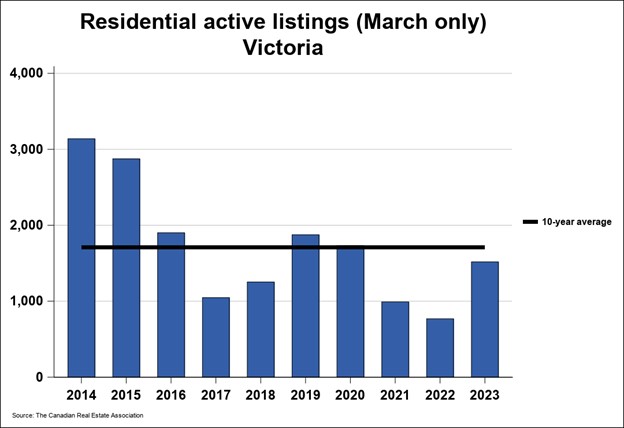
Although the Canadian Real Estate Board reported that active listings in Victoria had increased significantly in March 2023, when compared to the same month in the previous two years, it noted that more inventory is still needed to balance demand.

home listings victoria

Overall, there are several positive signs that confidence is starting to return to the Victoria housing market in 2023, such as:

  • Buyer demand is starting to bounce back.
  • Active listings are increasing.
  • Interest rates remain high, but buyers have more choice and less competition. 
  • The high-pressure sales market seen a year ago seems to be easing.
  • The home buyer rescission period, which was bought into effect in BC in Jan 2023, has given buyers more confidence.

BCREA Expects Strong Housing Market Recovery in 2024

So where do commentators think the Victoria housing Market will go over the rest of 2023 and into 2024?

The Vancouver Sun notes that BCREA is forecasting a province-wide 7% drop in sales by the end of 2023 as buyers struggle with high interest rates, but suggests this will reverse in 2024 with a rebounding 24% increase in sales.

For Victoria specifically, the BCREA suggests market changes will be more modest, with home sales falling by 3% and prices dropping by 5.7% on average by the end of 2023. These numbers are reflected in the table below, published by Real Estate Magazine.

Prices May Increase Again if Demand Outpaces Supply

While slow economics and elevated mortgage rates will continue to limit market growth during the rest of 2023, BCREA predicts that in 2024 we will see a strong recovery boosted by lowered interest rates and high immigration.

Mortgage Sandbox agrees that over the next year or so, the housing market will be impacted by: 

  • Federal immigration targets – which will bring more home seekers into communities.
  • Interest rates – while variable mortgages rose from 1.7% interest in January ‘22 to 6.4% in March ’23, many forecasts suggest interest rates will likely be lowered during 2024 once inflation is more under control. This will boost buyers’ confidence, leading to higher sales.

However, it’s worth noting that any significant increase in demand may be an issue for Victoria. CMHC, in a housing report for 2022, predicted that supply constraints would continue to impact major Canadian centres in the medium term for new housing supply.

If Victoria’s market returns to one where demand outstrips supply, prices could swiftly increase again. VREB Chair Graden Sol has noted that ‘If listings do not pick up…. there is a risk that the price stabilization could turn, and we could see prices increase.’

In summary, during the remainder of 2023, the Victoria real estate market will likely experience prices that are lower than in 2022 but slowly increasing. Sales will also increase as seller confidence returns. The ongoing demand for homes in Victoria, coupled with easing financial pressures is predicted to lead to a rebound in both sales and prices during 2024.

Trust D.Fritz in a Changing Property Market

In this ever-changing housing market, you can rely on D. Fritz Appraisals to provide a fast and accurate home appraisal that reflects the current situation.

We make it our priority to understand the Victoria, BC, housing market so we can provide up-to-date and helpful property appraisals, whether you are looking to sell, buy, remortgage or need a valuation for another purpose.

To arrange a property appraisal from a certified member of our team, contact us today.

_____________________________________________________

*Posted June 28, 2022

What do Experts Think the Victoria, BC Housing Market Will Look Like by 2027?

The state of Victoria’s housing market is never far from anyone’s mind, especially for first-time home buyers, those moving to a new area or for people looking to sell.

Between 2021 and 2022, house prices in the Victoria, BC region rose by an average of 20%. This significant increase came about due to the unprecedented combination of:

  • All time low mortgage rates
  • Higher disposable household income 
  • Significantly reduced housing inventory

While low mortgage rates created higher demand, the lack of available homes led to price increases and over-bidding.

Now, many people are asking when the market will correct itself. Although accurate predictions are impossible to make, it looks possible that there will be some slowing or reduction in house prices over the next five years.

Victoria’s House Prices are Up Over 20% Year Over Year

So says a report by VictoriaBuzz.com who also noted that prices on Vancouver Island as a whole rose by a whopping 32.8% in 2022 compared to 2021, putting homeownership further out of reach for many.

At the same time, inventory of available homes dropped significantly and BCREA Chief Economist Brendon Ogmundson is quoted as saying ‘While sales are not keeping pace with the unprecedented levels seen [in 2021], demand remains strong’.

Experts seem to agree that the accumulated gains from 2020-2022 are not sustainable and at some point, housing prices will fall. In a bid to control that reduction and avoid a crash like that seen in the US in 2008, the Bank of Canada increased interest rates throughout 2022 and it is predicted there will be further increases into 2023.

So, what impact is that likely to have on the Victoria, BC housing market in the coming 1, 2 and 5 years?

Pace of Real Estate Market Steady into Spring

In the Victoria, BC housing market, low inventory has continued to result in record low sales numbers. According to the Victoria Real Estate Board statistical round up for May 2022, sales were down 26.2% from 2021 – notably low for spring. And while they say that the recent interest rate increase and inflation have cooled demand slightly, there is still a lot of competition for each home on the market – especially those in lower price ranges.

Some good news came in a June 2nd piece in the Times Colonist – Victoria real estate market finally cooling off, but too late for some, which notes that housing inventory is finally picking up, with the number of houses available at the end of May up 30% compared to a year ago.

Opinions differ on what difference this will make to house prices though.

In their March 2022 article, Bubble burst risk: Canadian home prices predicted to fall by 24%, Urbanized.com states that the accumulated gains from 2020-2022 are not sustainable. They quote UK based research group Oxford Economics as predicting Canadian house prices could fall by 24% between the summer of 2022 and 2024.

This fall in prices isn’t likely to happen in Victoria though according to Mortgage Sandbox, who report values will continue to rise in 2022 across all housing categories. Although the rate of increase in price is slowing, there will still be a modest year on year increase of 8%.

An article from livabl.com supports this claim, listing Victoria as one of Five BC housing markets forecast to see the most price growth in 2022, and predicts house price increases of around 11% in the region by the end of 2022.

One thing most commentators agree on is that a sustained increase in inventory is the biggest influence on slowing or reversing price increases.

BC House Prices Forecast to Dip 3.8% Next Year

According to CTV News, RBC economists are predicting a moderate price correction in British Columbia in 2023, with average house prices expected to drop by 3.8%. They have suggested this will happen as a result of buyers being pushed out of the market as interest and mortgage rate increases shrink their available budget by up to 15%.

In turn, this reduced purchasing capacity will dampen some of the demand for available homes and reduce competition.

In their article ‘Will housing prices ever drop! Here’s what homebuyers should expect for the rest of 2022’, the fool.ca agrees with this prediction. They quote Moody’s Analytics as saying the Canadian Market likely won’t see any price correction before the end of 2023.

What Canadian Home Buyers Can Expect in the Next 5 Years

Unsurprisingly, long or even medium-term predictions are hard to come by, as no-one really knows what the impact of increased interest rates might be over time.

Narcity, in its article ‘Here’s what Canadian homebuyers can expect in the housing market over the next 5 years’ says that supply is the biggest issue affecting the housing market, and this might not change any time soon thanks to high material costs and construction labour shortages.

A recently released report by Leger and ReMax, titled– Unlocking the future, 5-year housing report, states that 61% of Canadians still see real estate as a good long-term investment, and 37% of people want to live in suburban areas, suggesting demand won’t be going away any time soon, especially for areas like greater Victoria.

It certainly seems like increasing home inventory is the only way to a market correction when it comes to price. As indicated by Storeys.com in its report, Speeding Up Development in BC Key to Calming Home Price Growth, in which it quotes a BCREA report as stating ‘If a flood of new completions (builds) were to enter the market and drive down the price of new homes, this will impact prices in the resale market (too)’

To summarize, in the short-term, Victoria, BC home prices will continue to increase but not at the same pace seen in the past year, while the chances of a longer-term correction appears to rely on more homes becoming available to buy.

Whatever the Market, Choose an Appraiser You Can Trust

At D.Fritz Appraisals Inc, we pride ourselves on staying up to date with the ever-changing housing market to ensure we offer accurate appraisals to sellers and buyers.

Based in Victoria and offering appraisal services across Vancouver Island and the Gulf Islands, we offer appraisal services to support mortgage approval, new construction valuation and inspections. Contact us today to book an appraisal.

property tax appeal

Need a Property Tax Appeal?

What to do When Your Property Tax Assessment Seems Too High

In early January each year, every home in British Columbia receives its property tax assessment notice through the mail from BC Assessment. Some property owners may be surprised and possibly even concerned with their home property assessment amount.

Between 2021 and 2022, house prices in BC rose by an average of 23.3% with the increase even steeper in Victoria.  With BC Assessments predicting that property assessments will rise between 5% and 15% for 2023, it’s no wonder homeowners are concerned about how these cumulative increases will affect their BC tax assessment.

The good news is, if you think your BC Property Tax assessment is too high, there is an appeals process that you can follow.

Read on for more about how your property tax assessment is calculated, what to do if you think your assessment is too high and how a professional appraisal company can help you with your appeal.

How Do BC Property Tax Assessments Work?

Every year, BC Assessment creates property tax assessments for over 2 million homes in BC. These assessments provide a valuation of each property as of July 1st in the previous year (So 2023 tax assessments are based on the value of homes on July 1st, 2022).

These assessments are used by local municipalities to calculate your annual property taxes. While the actual dollar valuation of the property is not the basis for your tax bill (i.e. an increase in property value doesn’t always mean an increase in taxes), if you’ve seen a larger-than-average increase (based on the average change in home values within your community), your bill could be affected.

BC property tax assessments are calculated using a variety of information sources, including:

  • Land title
  • Real estate transactions
  • Aerial and street view imagery
  • Building permits
  • Property visits

BC Assessment’s team of appraisers take this information and look at it alongside property market data from July 1st. Sales of comparable homes in the local area are analyzed along with specific features of each home to establish market value.

Things that may affect your BC Assessment valuation include:

  • Type of property
  • Location
  • View
  • Size of home in square feet
  • Number of rooms
  • Any recent additions / improvements
  • Age of home
  • Garages / carports / decks
  • Comparable sales prices

Did You Know? Changes to land zoning could impact your assessment. However, if you have owned and occupied your residential property for over 10 years, the valuation must remain based on current use, not potential use of the land. Therefore, any potential development due to zoning changes would not be valued. 

How to Appeal Your Property Tax Assessment

In their 2021 Annual Report, BC Assessment notes it received 4,427 appeals that year, 10% of which were from Vancouver Island. According to the Times Colonist, this number is well below the approximately 20% of homeowners who should be appealing their property assessments each year.

If you think your property tax assessment is too high, there are some steps you should take to decide whether you should appeal.

  • First, use the online assessment search tool to see what other homes in your area, and homes comparable to yours, have been assessed at. The important thing to look at is the % increase. You may find that although your value has increased a lot, it is in line with the average for your area and so there is no case for appeal.
  • However, if you feel your home has increased significantly compared to your neighbours and other comparable homes, then you may have a case for appeal.
  • BC Assessment suggests anyone with concerns should contact them to have an informal discussion with an appraiser. If both sides agree a change is needed it can be done without having to go through a formal appeal process. 96% of cases were solved this way in 2021.
  • If following this initial discussion, you are still not satisfied with the assessment, you can lodge a formal appeal and request an independent review by the Property Assessment Review Panel (PARP). The PARP has the authority to investigate and adjudicate assessments and can make rulings to amend the issued assessment.

Remember: You must submit your appeal by January 31 – late appeal submissions will not be considered.

Once you have submitted your appeal:

  • Appeal hearings take place between February 1st and March 15th. You will receive a notice of hearing time and date. It is important you start to gather support information as soon as you submit your appeal. (See below).
  • PARP may issue a decision at the hearing or by April 7 at the latest.
  • If you remain unhappy with the decision of the PARP you may refer your appeal to the Property Assessment Appeal Board. The deadline for appeals to PAAB is April 30.

How to Prepare Your Supporting Evidence Package

One of the most important things to do after submitting an appeal is to prepare your supporting evidence package. At the PARP panel hearing, you will be given 6 to 10 minutes to present evidence to support your claim that the tax assessment is incorrect.

This evidence package should include:

  • Comparative properties
  • Evidence of real home sales in your neighbourhood 
  • Photographs of your home and comparable properties
  • Evidence of views, condition of the home and any damage requiring repair 

For more information on the appeals process and what to include in your appeal evidence see this useful guide.

How an Independent Appraiser Can Help Your Appeal

The key to a good property tax appeal package is to be concise and include relevant and clear information.

Not everyone has the time or ability to do this, but did you know you can get assistance from an independent qualified appraisal company to create your BC Assessment appeal package? Appraisers are experts in the local market and can pull together comparison information and an accurate valuation to support your appeal.

While an appraisal for the purpose of a property tax dispute is somewhat different to a regular appraisal, because it has to reflect the market as of the previous July, a good appraisal company will be able to help.

Get Support in Your Property Tax Dispute From D.Fritz Appraisals Inc 

At D Fritz Appraisals Inc, we have over 24 years of experience appraising homes in the Victoria, BC, region and consider ourselves to be experts on Vancouver Island housing market conditions.

Not sure whether you have a good case to appeal property tax assessment? For a nominal fee, D.Fritz offers a telephone or online consultation to offer direction on whether you should proceed with your appeal or not.

If you decide to go ahead with an appeal, contact us at D. Fritz as soon as possible to book a time to carry out your appraisal.

home appraiser

Home Appraisals – What Do They Look For?

How Home Appraisers Decide on the Value of Your Property


There are many reasons you may need to know the value of your property and for this, you need a home appraisal.

Home appraisers are trained to inspect and measure your property and perform comparisons that result in an accurate valuation for the current housing market.

Home appraisals are a vital part of the home buying process as they have a big influence on the amount a lending institution will loan the buyer. They are also used to assess the value of the home for home improvement loans and insurance evaluations.

Read on for more information about how a home appraiser determines the value of your property.

What is a Home Appraisal and Why is it Important?

A home appraisal is a legal document containing information that determines the current fair market value of a new or existing property. Financial institutes or mortgage lenders will require an appraisal to ensure the home is worth the amount of money being requested in the loan or mortgage.

Home appraisals are not just for when someone is buying or selling a home for themselves however, they are also important for:

What is Checked During a Home Appraisal?

There are two main parts to a Home Appraisal:

  • Inspection of the property
  • Research and analysis of comparable properties

Property inspection: As part of the appraisal process, your home appraiser will conduct an on-site inspection of the property. During this inspection they are looking at:

  • General characteristics of the home:
    • Size of home – square footage, number of rooms – especially bed and bathrooms
    • Functionality of design and layout
    • Any exterior amenities such as garage, deck, pool
    • Type of foundation
    • Whether a basement or attic are present and their state of finish

Note that appraisers are not looking for any signs of damage to the foundation, basement, attic or mechanical equipment – that would be done by a home inspector as part of the conditions of sale.

  • Quality assessment:
    • Current condition of internal and external aspects of the home – including material and state of walls, floors, roof, windows
    • Type and age of plumbing and other systems (condition would be determined during a home inspection)
  • Any improvements that have been made:
    • Updates to kitchens and bathrooms
    • New efficient heating and cooling systems
    • Recent replacement of major ticket items like windows / roof
    • Energy efficient features such as HVAC, energy star appliances

Note: Home appraisers only look at the fixed features of the home. They are not assessing décor or any feature that is considered removable.

  • Lot:
    • Size and topography of the lot
    • View (including negative views)
    • Vehicular access
    • Any existing easements or zoning issues
  • Location:
    • How well does the home fit in with the surrounding neighbourhood?
    • Local amenities – how close is the home to hospitals, schools, shops and public transport corridors?
    • Crime levels and general condition of the neighbourhood

Comparison to similar properties: As part of the research involved in a home appraisal report, the appraiser will compare the home with others that have recently sold that:

  • Are in the same or similar neighbourhood 
  • Have comparable features such as size, number of rooms, age

The appraiser will review the sale price of these similar homes and make adjustments to account for any differences between them and the home being appraised.

How Does a Home Appraiser Determine Value?

When compiling their final report, home appraisers will determine the final value using a combination of two out of these three methods:

  • Direct comparison: Value is determined by analyzing comparable properties.
  • Cost approach: Value is derived from the cost to replace or rebuild the property and its associated land minus any age-related depreciation.
  • Income approach: Value is determined based on the rental income potential – usually only used when the property is being purchased for this purpose as an investment property.

The final appraised value of your home may be affected, either positively or negatively, by:

  • The location of the home
  • Current real estate market conditions
  • Size of home and number of rooms
  • Zoning in the neighbourhood
  • Future potential for development of the home

Things that can negatively impact the value of your property in a home appraisal include:

  • Delayed maintenance
  • Dated or undesirable features
  • Undeclared repairs
  • Inexperienced appraiser – make sure you choose a professional appraiser who is in good standing with the Appraisal Institute of Canada and who has a good understanding of the local market conditions where your property is located.

How Can You Help Improve the Appraisal Value of Your Property?

If you are preparing for an appraisal on your home there are a few things you can do to help improve the final appraised value, such as:

  • Prepare – treat an appraisal the same as a house viewing – present your home in its best light.
  • Simple fixes – repair minor damage, paint over marks on walls etc.
  • Paperwork – gather any relevant paperwork that supports the valuation of the home such as property tax bills, HOA fees, receipts and permits for any improvements or upgrades.

This pre-appraisal checklist for homeowners is a great starting point for anyone looking for the best ways to positively influence their final appraisal value.

Get Expert Help from a Local Qualified Home Appraisal Team

If you need an appraisal on your property for any reason, make sure you use an experienced and qualified appraiser like the team at D.Fritz Appraisals Inc. Based in Victoria, BC and offering home appraisals across Vancouver Island and the Gulf Islands, our team of appraisers are all in good standing with the Appraisers Institute of Canada and have superior knowledge of the local market.

Whether you are a property owner, real estate agent, mortgage broker or lawyer, we can provide quick and accurate home appraisal services. Contact us today to let us know how we can help with your home appraisal needs.

buying real estate online

Buying a House Sight Unseen – What You Need To Know

Online Home Buying Tips For Remote Purchasers

The real estate market has changed dramatically in recent years. Due to demand for homes being higher than supply, buyer preferences and buying methods have had to change and more people are resorting to buying real estate online or sight unseen.

When demand outweighs supply and quality homes enter the market, they often sell fast. This sometimes generates bidding wars and buyers need to move as quickly as possible, otherwise, they could miss out.

In a hot real estate market, you may even have to submit an offer before you get the chance to tour the house in person. 

This is why buying a house sight unseen has become an increasingly popular choice for buyers. 

While this may be a great strategy in a competitive real estate market, buying sight unseen can have its own set of challenges. 

What Does “Buying a House Sight Unseen” Mean?

Purchasing a home sight unseen means buying it without visiting the property first. 

Typically, home buyers will have looked at pictures and videos online. They’re likely to take a virtual tour as well. 

It may sound strange to buy a home without having set foot in it, however, buying sight unseen is becoming commonplace within the real estate market. 

Why Buying Sight Unseen Has Become Popular

As more people are choosing to relocate to BC and Vancouver Island from out of province, more homes are getting bought sight unseen. 

We know that prospective home buyers have to move quickly in a competitive housing market, but there are a number of reasons why buying a house online has surged in recent years.

  • Physical distancing – these past couple of years have played a tremendous role in how prospective buyers make offers on properties. Why risk going into other people’s homes when it’s safer to limit physical contact?
  • Modern technology can give us higher quality photos and videos than ever before. This can give a much better sense of what the home looks like. 
  • If you are moving from out of the area, It can be costly and time-consuming to travel to view potential homes. A remote buyer can rely on an experienced real estate agent or broker to find the best property and receive their own personal virtual tour of the home via a video chat app.

Even with a trusted real estate professional on your side, you should always choose to get a professional inspection and appraisal of the home to give you peace of mind during the process. 

How To Make A Sight Unseen Home Purchase

Buying sight unseen isn’t that different in comparison to a traditional home purchase.

Instead of an in-person tour, you’re using online photos, videos, and virtual tours to help you make an informed decision. 

It’s a good idea to hire an experienced real estate agent who knows the area well. Always communicate exactly what you’re looking for, and keep your list of must-haves for your dream home as refined as possible. 

Think about the size, location, and house style you’re looking for. Leave out any minor details that can slow down the search process. 

If there are any deal-breakers, let your real estate agent know early on. This is so they don’t waste any time looking at the wrong properties. 

An experienced real estate agent will be able to deal with any issues should they arise. 

Steps to buying a property sight unseen:

  • Evaluate the property remotely using photos, videos, facetime or video tours and descriptions provided by your real estate agent
  • Get pre-approved for a mortgage to show the current owner/seller you can afford to finance the home
  • Make an official offer to purchase the property from the seller
  • If the seller likes the offer and accepts it, you and the seller (or the lawyers) prepare the contract
  • Both parties sign the contract
  • You make a non-refundable deposit on the house
  • You have the property inspected and appraised before you remove conditions (Note that buying a home sight unseen often means not even having the opportunity to do an appraisal or home inspection. This is NOT advisable in most cases!)
  • If you’re satisfied with the inspection and appraisal, the sale continues and you finalize the details with your lawyer and the bank.

As with any home purchase, you’ll schedule a closing date to sign your final loan documents.

Once the mortgage is finalized, your lender pays the home seller, and the home title transfers over to you. Congratulations! You’re now the official homeowner. 

Pros & Cons Of Buying A House Sight Unseen

Pros of buying a home sight unseen:

  • You may purchase the property for less because you moved quickly enough to avoid a bidding war
  • Virtual home tours can be helpful when buying an out-of-province home
  • Virtual home tours can save money on costly travel expenses

Cons of buying a home sight unseen:

  • You won’t have the privilege of an in-person tour
  • You’ll have to rely on photos, videos, virtual tours, and the advice of your real estate agent and (possibly) a home inspector
  • There’s a higher chance of failing to see issues with the property
  • You may offer more than you’re willing to pay just to secure a home sale

While everyone wants to save money during the home buying process, don’t be tempted to cut corners on home inspections and appraisals. 

It’s always going to be in your best interest to get a professional inspection, especially when you’re buying sight unseen. 

Keep a close eye on the inspection report and the seller disclosures so there aren’t any surprises later.

Remember to ask a lot of questions before you purchase a home. When buying sight unseen, you’ll need to ask even more. It may feel like a burden but think of questions you normally wouldn’t ask. 

Take Extra Steps To Protect Yourself  When Buying a House Online

A professional inspection and appraisal is your one chance to get the current owner to cover repair costs. Or walk away if the issue is a deal-breaker. 

This is why a home inspection and appraisal are so important, especially when you’re buying sight unseen. This is your best defense against any major issues the current owner may have neglected to disclose.

While sellers might not like having conditions attached to the sale, it’s a good strategy which allows you to ask for more time, negotiate repairs, or back out based on findings from your home inspection and appraisal. 

Purchasing a home sight unseen is certainly riskier than the “normal” way of buying a home (i.e. doing a walkthrough and getting a home inspection and appraisal done). This is why it’s important to hire an experienced real estate agent and get a professional inspection and appraisal.

If you need an inspection or appraisal on a home in the southern and central Vancouver Island area, Contact D. Fritz Appraisals, who can provide an expert assessment of your future dream home. 


investment property appraisals

Home Appraisals for Rental Properties

Investment Property Appraisals – What You Need to Know

Let’s take a look at investment property appraisals because it doesn’t look like our gold rush of a real estate market is slowing down anytime soon. Perhaps your family has outgrown your home and are thinking of moving but would like to keep your current place of residence.

Mortgages, property taxes, and utilities aren’t going to get much cheaper, so what’s a viable solution? 

If you are planning on moving or looking for more passive income, it might be time to rent out your property.

While having a new stream of cash flow can be exciting, you’ll also be taking on the role of a landlord. 

However, before you take on this exciting challenge, you’ll need a rental property appraisal first.

At D. Fritz Appraisals Inc., our team offers the most accurate, fair value assessments for rental properties. 

Why Rent Out Your Property?

Typically, when people sell their homes, they use the equity they have built in one house and use it on the next. But that’s not always the case.

Some homeowners will convert their primary residence to an investment property, and it’s usually done for one of two reasons.

  1. A homeowner might do this because the housing market is struggling, and they’re concerned their home’s value has dropped. By renting it out instead of selling it, they can hold on to the property and wait for the value to rise again. 
  2. Another reason to rent out your home is to increase your monthly income. By converting your primary residence to an investment property, your family can enjoy the perks of having their mortgage payments paid for.

But what’s the difference between a primary residence and investment property?

What Makes a Primary Residence or Investment Property?

Whether it’s a house or an apartment, you can only own one primary residence at a time.

If you are buying a home as a primary residence, you may be able to receive lower interest rates and lower down payments. Depending on where you live, you might be able to apply for tax benefits. 

An investment property is purely to generate income. If you are purchasing a home or apartment as an investment property, you may need a larger down payment and pay a higher interest rate.

Whether you are converting a primary residence to a rental property or purchasing an investment property, it can have its own set of challenges. 

What to Consider Before Renting Out Your Real Estate

One of the most important things to consider is your mortgage agreement. Typically, when you sign a mortgage, you must live in your primary residence for 1 to 2 years. If enough time has passed and you want to convert your primary residence to an investment property, you are free to do so.  

When your primary residence changes over to an investment property, your taxes are likely to change. You can benefit from a wide variety of deductions on your taxes, utilities, and much more.

Finally, you’ll need to speak to your insurance company. Switching from your current house insurance to rental insurance will likely increase your rates. This covers your building, but not your renters’ belongings – they would have to get their own renter’s insurance. 

With all of these things to consider, it’s time to get your investment property appraised. But how do professionals find an accurate assessment?

How to Value Your Real Estate Rental Property

With income from investment properties at an all-time high, rentals can offer an increasing source of revenue for your family.

While there isn’t just one solution to appraise your property, a combination of different methods can help you find an accurate assessment.

Here are some of the more common ways to value your rental property:

  • The Sales Comparison Approach

SCA is one of the most popular ways of valuing residential real estate. This involves a comparison of similar homes that have been sold or rented locally over a certain period. 

  • The Capital Asset Pricing Model

CAPM is a more comprehensive valuation model. This details the potential return of investment from your rental property and whether or not it’s viable. 

  • The Income Approach

This indicates the potential income for your rental property, compared to the initial investment. This approach is commonly used for commercial real estate investing. 

  • Gross Rent Multiplier Approach

GRM will value a rental property based on the amount an investor can potentially collect every year. While it’s easy to measure whether or not a property is worth the investment, this won’t take taxes, insurance, utilities, and other expenses into account. 

  • The Cost Approach

This model combines the land value and the depreciated value of any home improvements. While this approach can value newer homes reliably, it may not work for older properties. 

For more in-depth details about the appraisal process, feel free to contact us with any questions you may have. 

Deducting Taxable Income 

One of the benefits of owning a rental property is claiming tax deductions for any expenses related to the property. You can claim rental income and additional expenses on “Form T776”. 

The most common rental expenses can include:

  • Home insurance
  • Heat
  • Hydro
  • Water
  • Mortgage insurance

Claiming these expenses will save you money in tax deductions, but why not take it a step further? As long as it’s concerning your rental property, you can claim so much more.

You can deduct additional expenses such as:

  • Advertising your rental property
  • Bank fees and interest
  • Property taxes
  • Cable
  • Office expenses
  • Travel if your rental is in a different municipality
  • Repairs and maintenance
  • Salaries and management

Some expenses can be deducted in full if it’s spent to maintain the rental property. However, if your rental is a part of your primary residence, you can only claim a certain percentage.

Much like anything home-related, there are always stipulations on how much you can deduct. Check out rental expenses you can deduct from the Canada Revenue site to learn more. 

Get Your Fair Value Rental Assessment Today

While there is no one way to appraise the value of a rental property, it’s important to look at the different valuation methods before making an investment decision. 

By learning these valuation concepts and researching how to save on expenses, you could be well on your way to getting into the real estate investment market.

At D. Fritz Appraisals Inc., our team has over 40 years of experience appraising homes, offering the most precise assessment according to the market today. Our appraisers are certified, professionally insured, and committed to the appraisal process every step of the way.

 Contact us today for a professional appraisal of your rental property. 

We’re Hiring!
close slider

Job Title: AIC Candidate Appraiser

D. Fritz Appraisals Inc. is an established Real Estate Appraisal company that has been part of the Capital and Cowichan Valley community since 1998. We are excited to announce our company is ready to grow again and are searching for an AIC Candidate Appraiser to join our busy team to expand up-island in Nanaimo and the surrounding area.

The position available will be an independent contract, with a commission-based fee split. The successful Candidate will work under and be mentored by our AACI designated Appraiser. Our small team also consists of a CRA designated Appraiser (owner), three other AIC Candidates, and two Office Administrators. This is a work from home position, with an online virtual office to maintain and encourage communication and teamwork within the company. All computer software will be provided.

Responsibilities Include:

·      Perform on-site inspections, ensuring measurement accuracy, taking photographs and data collection;

·      Pull comparable sales and assign values to complete appraisal reports efficiently;

·      Meet turnaround times to ensure client satisfaction;

·      Develop relationships with lenders, brokers, clients, and other members of the public;

·      Continuously improve their knowledge regarding cost, market, and valuation trends;

·      Abide by all company policies and procedures­­­;

·      Attend staff meetings as required.

Qualifications Needed:

·      Valid Driver’s License and driving record that meets company standards

·      Clean Criminal Record check

·      A keen interest and knowledge of Vancouver Island’s real estate market

·      Registered Candidate Appraiser with the Appraisal Institute of Canada (AIC)

·      Must have proficient writing skills, be thorough and attentive to detail

Please forward a PDF copy of your resume and cover letter to [email protected].